
How to Grade Basketball Cards: Is It Worth It?
How to grade basketball cards step by step: inspection, comps, cost-benefit math, choosing PSA, BGS or SGC, and protecting high-value submissions.
Grading can multiply a card's value, or cost you money for nothing. On the 1986 Fleer Michael Jordan, for example, PSA's own sales data shows PSA 8s selling for a few thousand dollars and a PSA 10 reaching $840,000 at the 2021 peak. That gap is why collectors grade. But most cards will not reach the top grade, and fees, shipping and insurance add up. This guide gives you a step-by-step process for deciding whether to grade a basketball card, and how to do it safely when the card is valuable.
The Six-Step Grading Decision
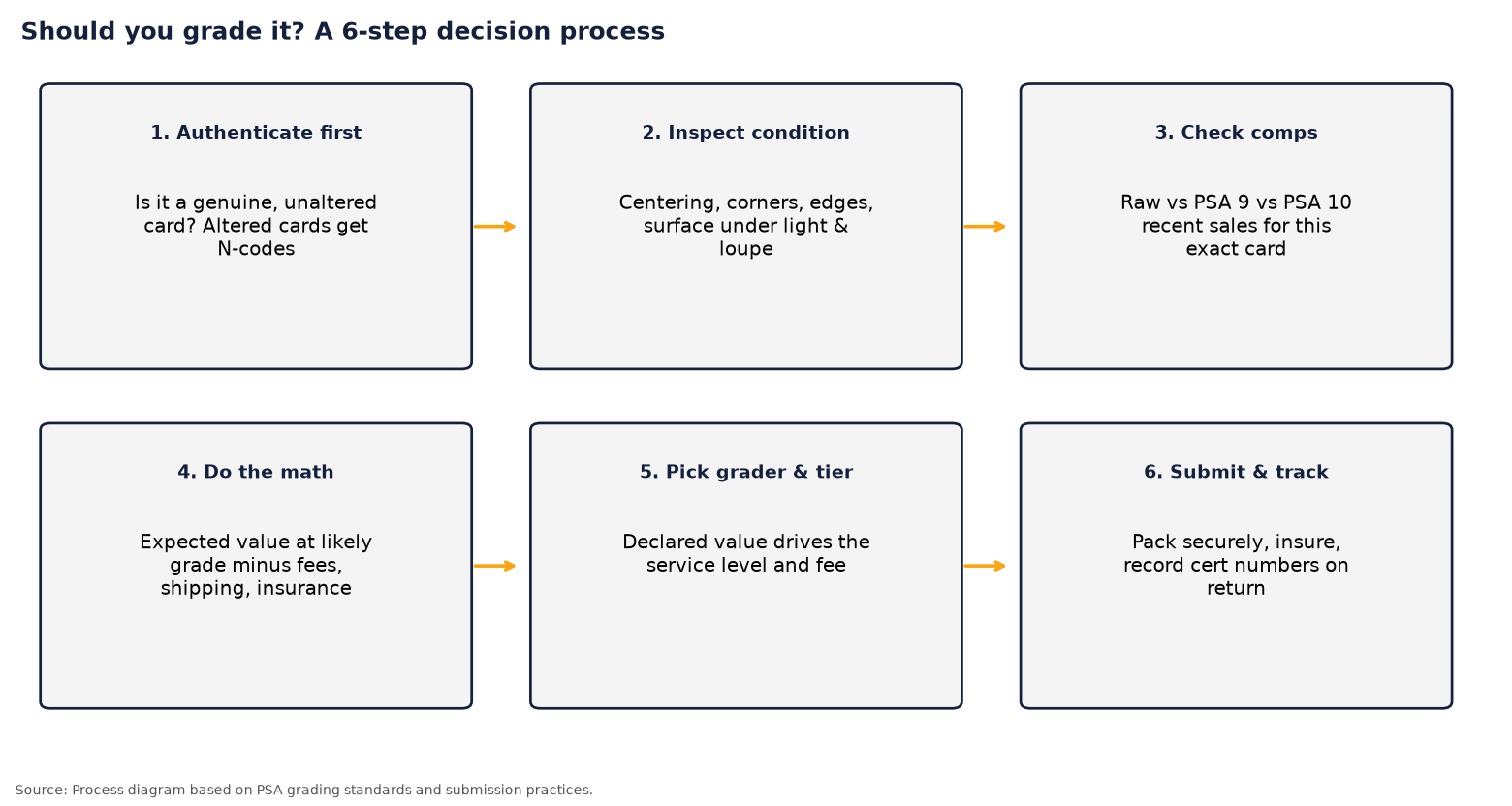 Figure: A six-step process for deciding whether to grade.
Step 1: Make sure the card is authentic and unaltered
Grading companies will not give a numeric grade to cards that are altered or questionable. PSA's standards list "No Grade" codes for trimming (N1), restoration (N2), recoloration (N3), questionable authenticity (N4), altered stock (N5), cleaning (N7) and others. You still pay the grading fee in most of those cases. If a card has been cleaned, pressed or trimmed, do not submit it expecting a grade.
Step 2: Inspect the condition yourself
Use good light, a loupe or magnifier, and a centering tool. Check four things:
- Centering: PSA's Gem Mint 10 requires about 55/45 or better on the front and 75/25 on the back. Mint 9 allows about 60/40 on the front.
- Corners: any whitening or softness lowers the grade.
- Edges: chips and roughness, especially on colored borders.
- Surface: scratches, print lines, dents, staining and loss of gloss. Chromium cards show surface flaws clearly.
Step 3: Pull comparable sales at each likely grade
Look up recent realized prices for the exact card and parallel in raw, PSA 8, PSA 9 and PSA 10 condition. PSA's Auction Prices Realized pages and auction archives are good places to start.
Step 4: Do the expected-value math
Estimate the grade you are likely to get, not the one you hope for. Then compare:
- Raw value today
- Graded value at your realistic grade
- Total cost: grading fee (based on declared value and service tier), shipping both ways, insurance and time
If the likely graded value minus costs is not clearly above the raw value, do not grade, unless you are grading for authentication, protection or personal reasons.
Step 5: Choose a grader and service level
- PSA offers the most liquidity. It graded 15.34 million cards in 2024 (Sports Illustrated).
- BGS gives subgrades and the chance of a Black Label (four perfect 10s).
- SGC offers 10 Pristine and 10 Gem Mint designations.
See PSA vs BGS vs SGC and BGS Black Label explained.
Step 6: Submit securely and track it
Pack cards in sleeves and semi-rigid holders, protect the package from bending, insure the shipment, keep a submission record and photos, and log every cert number when the cards come back. Verify each cert on the grader's website.
When Grading Is Usually Worth It
High-value cards with a real shot at a top grade
Modern chromium rookies of star players, pack-fresh and well-centered, are the classic case. On the Luka 2018-19 Prizm Silver, 2,253 of 5,174 PSA-graded copies (about 43.5%) received a 10 by late 2023 (Graded Card Investor). Good modern cards do gem at meaningful rates.
Vintage or junk-wax icons in strong condition
Older cards are harder to grade but carry bigger premiums. The 1986 Fleer Jordan's PSA 10 rate was about 1.6% in 2021 (Yahoo Sports), which is why a PSA 10 is worth so many times a PSA 8.
Cards you plan to sell
Graded cards are easier to sell and price because buyers trust the authentication and condition rating.
Valuable cards that need authentication
For autographs and expensive cards, grading confirms that the card is genuine, which protects both buyer and seller.
When Grading Is Usually Not Worth It
- Cards worth less than the total grading cost, unless you are grading for personal reasons.
- Cards with obvious flaws, such as creases, heavy wear or bad centering, where the likely grade adds little value.
- High-population modern base cards where even PSA 10s sell cheaply.
- Cards that may be altered.
Special Considerations for High-End Cards
Thick patch and autograph cards
RPAs and Logomans are thick, and their edges and corners wear easily. Make sure the grader's holder fits the card, and consider asking for an autograph grade.
Declared value and insurance
High-value submissions usually require higher service tiers based on declared value. Confirm how the grader and the shipping carrier cover the card in transit. See sports card insurance.
Use a trusted intermediary, or submit directly
Some collectors use auction houses or submission services for convenience. Others submit directly. Either way, document everything.
Think twice before cracking a slab
Resubmitting a graded card to try for a higher grade can lower the grade instead. Many collectors leave legacy high-grade slabs untouched.
Preparing Cards Before Submission
- Handle cards by the edges with clean, dry hands.
- Sleeve right away, then place each card in a semi-rigid or rigid holder as the grader requires.
- Do not clean or press cards. PSA treats cleaning and altered stock as no-grade conditions.
- Photograph front and back at high resolution for your records.
- Store cards properly while you wait. See how to store sports cards.
Understanding Your Results
Once your cards return:
- Read the full label, including qualifiers and any autograph grade.
- Check the pop report for your card at your grade.
- Verify the cert on the grader's website.
- Decide whether to sell or hold based on recent comps, not peak prices.
For grade definitions, see the PSA grading scale explainer.
A Worked Example (Using Published Prices)
PSA's APR snapshot for the 1986 Fleer Jordan listed recent eBay sales of about $5,000 for PSA 7s and about $7,000–$8,000 for PSA 8s in early 2025, with a most recent PSA 10 at $217,294.80. Suppose you own a raw copy that you believe grades PSA 7 or 8. Grading it adds a few thousand dollars of verified value. That easily covers fees, and it gives you authentication on one of the most counterfeited cards in the hobby (Yahoo Sports). A realistic shot at a PSA 10 would be a far bigger payoff, but only about 1.6% of submissions reach that grade. Plan around the likely outcome, not the best case.
FAQ
How do I know if my card is worth grading?
Compare recent sales of the raw card with sales at the grade you realistically expect, then subtract all costs. Grade it if the difference is clearly positive, or if you need authentication.
What grade do most cards get?
It depends on the era and the card. In late 2023, about 43.5% of PSA-graded Luka Prizm Silvers were 10s, compared with about 1.6% for the 1986 Fleer Jordan in 2021.
Should I clean a card before grading?
No. PSA lists evidence of cleaning (N7) and altered stock (N5) as reasons it will not grade a card.
Which grading company is best for basketball cards?
PSA for liquidity, BGS for subgrades and Black Label potential, and SGC for its Pristine and Gem Mint 10 designations and holder style.
Can I submit high-value cards myself?
Yes, but insure them, document them, and choose a service level that matches the declared value.
Related Articles (Internal Links)
- PSA Grading Scale Explained: 1 to Gem Mint 10
- PSA vs BGS vs SGC: Best Grader for Basketball Cards
- BGS Black Label: What It Is and Why It Sells
- How to Store Sports Cards Safely: A Collector's Guide
- Sports Card Insurance: How to Protect Your Collection
Sources
- PSA, "Grading Standards". https://www.psacard.com/gradingstandards
- Sports Illustrated Collectibles, "20 Million Cards Were Graded In 2024". https://www.si.com/collectibles/20-million-cards-were-graded-in-2024
- PSA, Auction Prices Realized: 1986 Fleer Michael Jordan #57. https://www.psacard.com/auctionprices/basketball-cards/1986-fleer/michael-jordan/299576
- Yahoo Sports, "Has the bubble burst on Michael Jordan's iconic 1986 Fleer rookie card?" (Jun 3, 2021). https://sports.yahoo.com/nba-has-the-bubble-burst-on-michael-jordans-iconic-1986-fleer-rookie-card-152457795.html
- Graded Card Investor, "Best Luka Doncic Rookie Cards - Recent Prices & Value" (late 2023). https://gradedcardinvestor.com/top-20-luka-doncic-rookie-cards-to-buy-now/
- Beckett News, "Introducing BGS Black". https://www.beckett.com/news/introducing-bgs-black/
- SGC, "Grading Scale". https://www.gosgc.com/card-grading/scale
- PSA, "Cert Verification". https://www.psacard.com/cert/
Figures are reported prices from the cited sources at the time of research (October 2026). Private-sale prices are as reported and were not independently audited. Nothing here is financial advice.