
How to Spot Fake Graded Cards and Altered Slabs
How to spot fake graded cards: cert checks, slab red flags, trimming and other alterations, shill bidding history, and a 7-point checklist for buyers.
As prices have climbed, so has fraud. PSA's 2025 Fraud Report says the company intercepted more than $200 million in projected fraudulent collectibles, and it warns that counterfeits are "more frequent, more sophisticated, and harder to spot than ever." For high-end basketball cards, a single mistake can cost five, six or seven figures. This guide covers how to spot fake graded cards, altered cards and auction manipulation, with a seven-point checklist you can use on every purchase.
The Three Main Fraud Risks
- Counterfeit cards and counterfeit slabs: fake cards, or real-looking holders with forged labels.
- Altered cards: genuine cards that have been trimmed, recolored, restored, cleaned or pressed to look better.
- Market manipulation: shill bidding and misleading listings that inflate prices.
The 7-Point Buyer Checklist
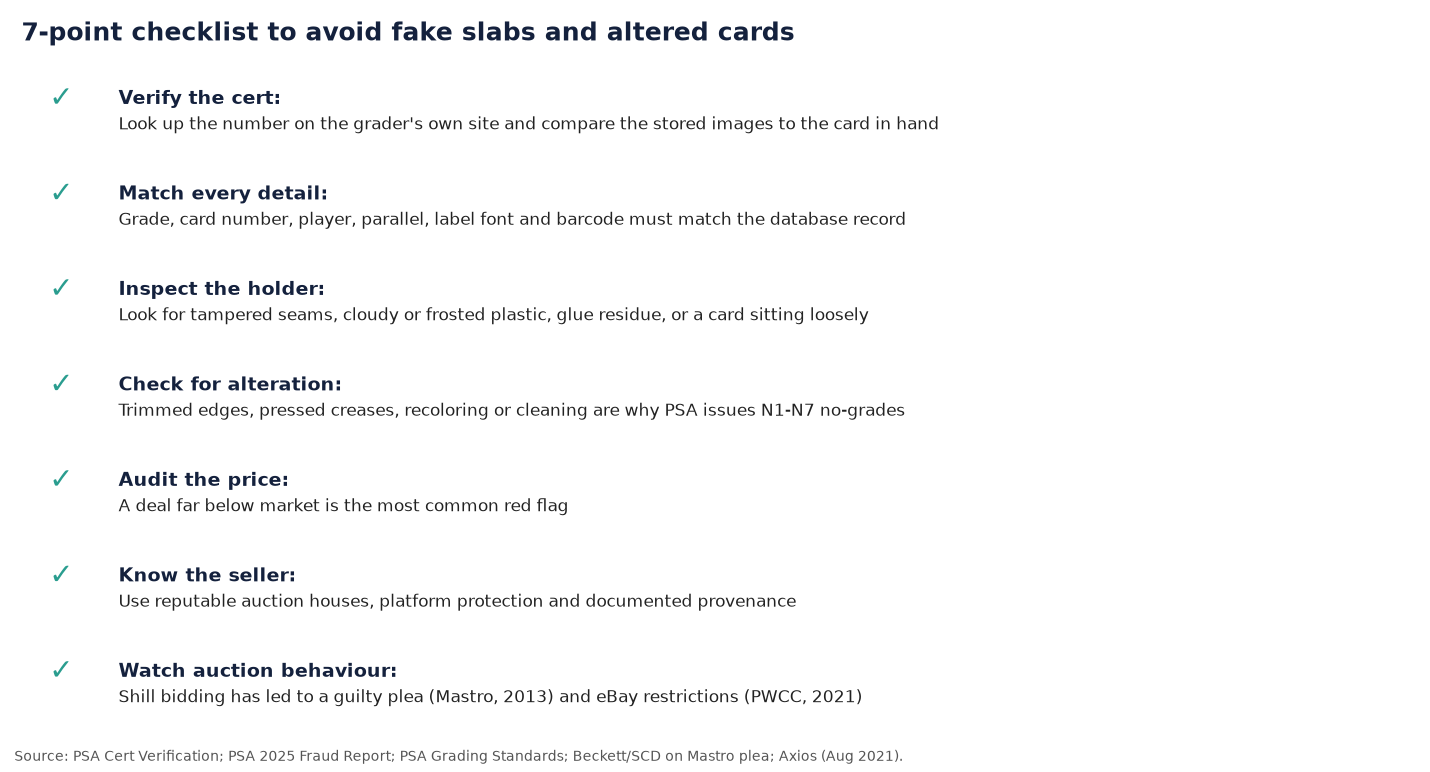 Figure: A seven-point checklist for avoiding fake slabs and altered cards.
1. Verify the cert number yourself
Look up the certification number on the grader's own website, such as PSA Cert Verification. Type the URL yourself rather than clicking a link a seller sends you. Where the grader stores images, compare them closely with the card in front of you.
2. Match every detail
The player, year, set, card number, parallel, grade and autograph grade must all match the database. A real cert number on a fake label is a known scam: the number checks out, but it belongs to a different card.
3. Inspect the holder
Warning signs include tampered or uneven seams, cloudy or frosted plastic, glue residue, label fonts or holograms that look wrong, and a card that moves around inside the holder or sits crooked.
4. Look for signs of alteration
PSA's grading standards describe how alterations show up. Trimmed edges can look "hooked," unusually sharp for the issue, inconsistent in tone, or wavy. Recoloring, restoration, cleaning and pressed creases are other common methods. A legitimately graded card should already have passed these checks, but raw cards have not.
5. Audit the price
A deal far below market value is the most common red flag. Compare against recent realized prices for the same card and grade.
6. Know the seller and the platform
Buy from reputable auction houses and dealers, use platforms with buyer protection, and keep records of every communication.
7. Watch how the auction behaves
Strange bidding patterns can point to manipulation. Bid only what the card is worth to you.
How Graders Flag Altered Cards
PSA publishes "No Grade" codes for cards it will not grade numerically:
- N1: evidence of trimming
- N2: evidence of restoration
- N3: evidence of recoloration
- N4: questionable authenticity (never encapsulated)
- N5: altered stock (pressing, scratch removal, gloss enhancement, foreign substances)
- N7: evidence of cleaning
PSA states it "will not grade cards that bear evidence of trimming, re-coloring, restoration, or any other forms of tampering, or are of questionable authenticity." A raw high-value card with a suspicious history should be graded before you pay a graded price. See the PSA grading scale explainer.
Historical Cases Every Collector Should Know
The Mastro case: trimming and shill bidding
Bill Mastro, founder of Mastro Auctions, pleaded guilty to mail fraud in a case built around shill bidding at his auction house. During his plea, he admitted trimming the famous T206 Honus Wagner card and not disclosing it (Sports Collectors Digest). He was sentenced to 20 months in federal prison (Beckett). It is a baseball case, but the lesson applies to basketball: alteration and auction manipulation have reached the very top of the hobby.
eBay and PWCC (2021)
In August 2021, Axios reported that eBay restricted PWCC's selling privileges over alleged shill bidding. PWCC denied the allegations and said it was already moving off eBay. PWCC later became Fanatics Collect. The episode is a reminder to judge bidding activity critically, wherever you buy.
Counterfeits of Iconic Cards
The 1986 Fleer Michael Jordan is a frequent target. Yahoo Sports reported that collectors believe there "might be more fake '86 Jordans in the wild than any other card," and that the forgeries are getting better. PSA also refuses to grade the earlier 1984-85 Star Company Jordans because of high forgery rates. If you are buying a Jordan rookie, buy it graded and verify the cert. Our 1986 Fleer Jordan guide has more.
Patch and Autograph Risks
Patch tampering
Memorabilia cards can be opened and their patches swapped for more attractive ones, such as a fake "Logoman" patch. Authenticated, encapsulated examples with a clear history reduce this risk.
Read the card back
Genuine cards carry specific material language. Wembanyama's $528,000 National Treasures Logoman, for example, states that its material "is not associated with any specific player, game, or event" (Yahoo Sports/cllct). Knowing the correct wording for a product helps you spot fakes and misleading listings.
Autographs
Get autographs authenticated, ideally with an autograph grade on the slab. ESPN noted that the record Jordan/Kobe card's value is supported by Upper Deck working directly with the athletes and by PSA authentication.
Red Flags in Listings
- Stock photos or blurry images instead of clear photos of the actual card.
- A cert number that is cropped, hidden or "available on request."
- Pressure to close a deal quickly or off-platform.
- Payment methods with no buyer protection.
- Prices far below recent comps.
- Sellers who refuse in-person inspection or independent verification on expensive items.
What to Do If You Suspect Fraud
- Stop the transaction if it is not complete.
- Document everything: listings, messages, photos and payment records.
- Contact the grading company with the cert number and photos.
- Report it to the platform and use its buyer-protection process.
- Contact law enforcement for significant losses.
Prevention Is Cheaper Than Recovery
At the high end, pay for certainty. Buy from established auction houses, verify every cert, inspect slabs carefully and keep documentation. For the selling side, see how to sell high-end sports cards, and compare auction venues in our auction house guide. For differences between graders, see PSA vs BGS vs SGC.
FAQ
How can I tell if a PSA slab is fake?
Verify the cert on PSA's website, match every label detail and image to the database, and inspect the holder for tampered seams, cloudy plastic and wrong fonts. A valid number alone is not enough.
What is card trimming?
Cutting a card's edges to make the corners and edges look sharper. PSA flags it as N1 and will not grade trimmed cards.
What is shill bidding?
Bidding by people connected to the seller to push up the price. It was central to the Mastro Auctions fraud case and to eBay's 2021 restriction of PWCC, which PWCC denied.
Is the 1986 Fleer Jordan often counterfeited?
Yes. Collectors interviewed by Yahoo Sports said it may be the most counterfeited card in the hobby. Buy graded and verify the cert.
How much fraud does PSA catch?
PSA's 2025 Fraud Report says it intercepted more than $200 million in projected fraudulent collectibles.
Can a graded card still be altered?
Graders screen for alterations, but no process is perfect. Slabs can also be tampered with after grading. That is why inspecting the holder and buying from reputable sources still matters.
Related Articles (Internal Links)
- PSA Grading Scale Explained: 1 to Gem Mint 10
- PSA vs BGS vs SGC: Best Grader for Basketball Cards
- Goldin vs Heritage vs Fanatics Collect: Card Auctions
- 1986 Fleer Michael Jordan Rookie Card Value Guide
- How to Sell High-End Sports Cards for Top Dollar
Sources
- PSA, "2025 Fraud Report". https://www.psacard.com/info/fraud-report
- PSA, "Cert Verification". https://www.psacard.com/cert/
- PSA, "Grading Standards". https://www.psacard.com/gradingstandards
- Sports Collectors Digest, "Bill Mastro Pleads Guilty, Admits Trimming Famous Wagner Card". https://sportscollectorsdigest.com/collecting-101/mastro-pleads-guilty-admits-trimmed-wagner
- Beckett News, "Bill Mastro sentenced to 20 months in federal prison". https://www.beckett.com/news/bill-mastro-sentenced-to-20-months-in-federal-prison/
- Axios, "eBay suspends trading card marketplace PWCC for dishonest bidding practices" (Aug 20, 2021). https://www.axios.com/2021/08/20/ebay-suspends-pwcc-shill-bidding-trading-cards
- Yahoo Sports, "Has the bubble burst on Michael Jordan's iconic 1986 Fleer rookie card?" (Jun 3, 2021). https://sports.yahoo.com/nba-has-the-bubble-burst-on-michael-jordans-iconic-1986-fleer-rookie-card-152457795.html
- Yahoo Sports / cllct, "Victor Wembanyama Logoman 1/1 sells for $528k in Fanatics Collect Premier Auction" (Mar 2025). https://sports.yahoo.com/article/victor-wembanyama-logoman-1-1-040000738.html
- ESPN, "'Holy grail' Jordan-Bryant sports card sells for record $12.9M" (Aug 2025). https://www.espn.com/nba/story?_slug_=holy-grail-jordan-bryant-sports-card-sells-record-129m&id=46061949
Figures are reported prices from the cited sources at the time of research (October 2026). Private-sale prices are as reported and were not independently audited. Nothing here is financial advice.