
Investing in Basketball Cards: Risks and Real Returns
Investing in basketball cards: real price swings on Jordan, Luka, LeBron and Wemby cards, the main risks, and a practical framework for high-end buyers.
Basketball cards have produced some of the most dramatic gains in collecting, and some of the most painful losses. A 1986 Fleer Michael Jordan PSA 10 went from about $40,000 at the end of 2019 to $840,000 in 2021. Luka Doncic's National Treasures RPA fell 75% in a year. If you are thinking about investing in basketball cards, especially at the high end, you need to understand both sides. This guide uses real point-to-point price changes to show how the market behaves, then gives a practical framework for buying. Nothing here is financial advice.
Real Price Swings, Not Hypotheticals
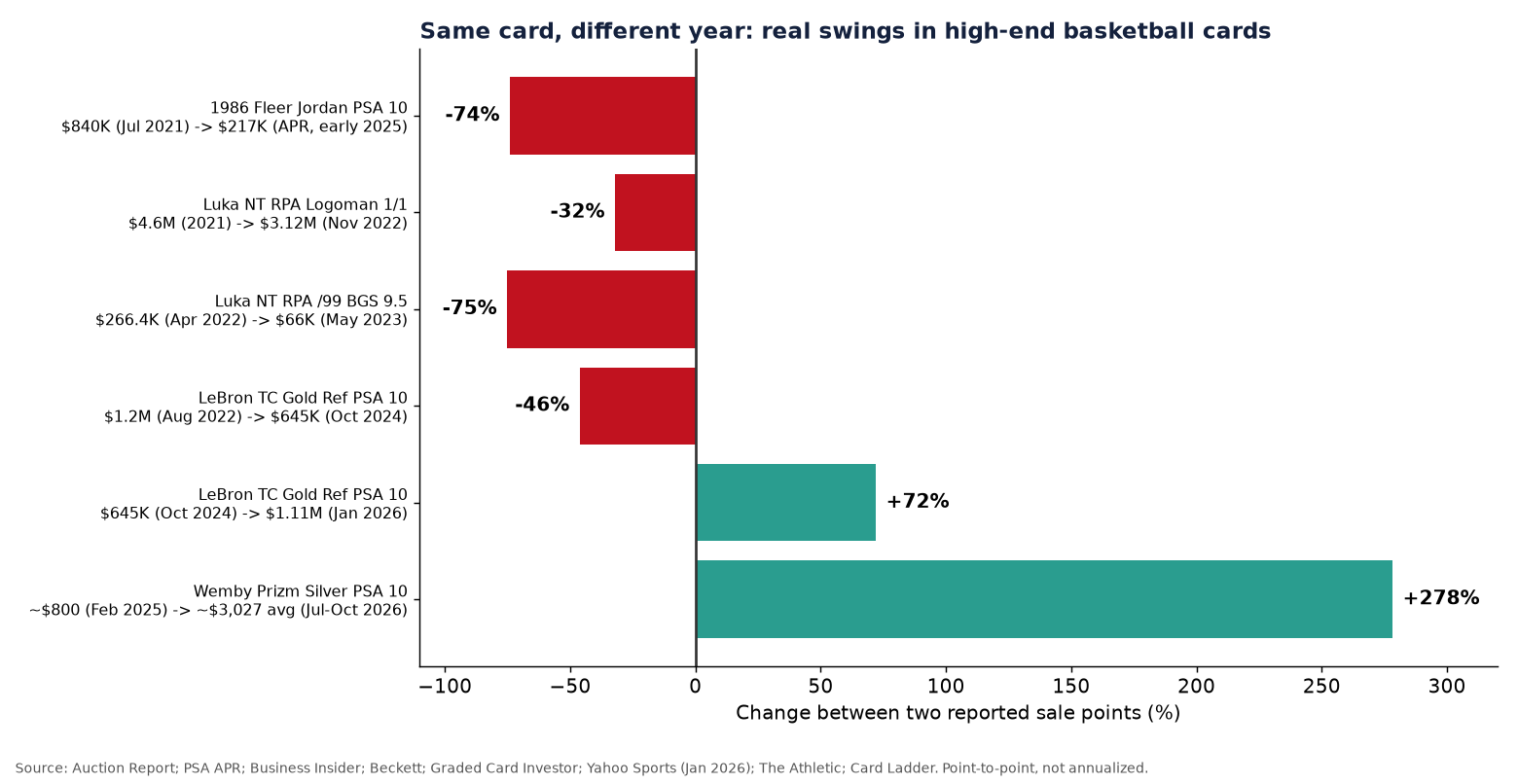 Figure: Point-to-point changes between two reported sale points for the same card. These figures are not annualized and ignore fees.
| Card | From | To | Change |
|---|---|---|---|
| 1986 Fleer Jordan PSA 10 | $840,000 (Jul 2021) | $217,294.80 (PSA APR, early 2025) | about −74% |
| Luka NT RPA Logoman 1/1 | $4.6M (private, 2021) | $3.12M (public, Nov 2022) | about −32% |
| Luka NT RPA /99 BGS 9.5 | $266,400 (Apr 2022) | $66,000 (May 2023) | about −75% |
| LeBron TC Gold Refractor PSA 10 | $1.2M (Aug 2022) | $645,000 (Oct 2024) | about −46% |
| LeBron TC Gold Refractor PSA 10 | $645,000 (Oct 2024) | $1.11M (Jan 2026) | about +72% |
| Wembanyama Prizm Silver PSA 10 | ~$800 (Feb 2025) | ~$3,027 avg (Jul–Oct 2026) | about +278% |
What these numbers show: 1. Drawdowns of 50–75% happen, even on blue-chip cards of all-time greats. 2. Recoveries happen too. The LeBron Gold Refractor nearly doubled in 15 months. 3. Your entry point matters a great deal. Buying a Jordan PSA 10 in 2019 and buying one in mid-2021 led to opposite results.
Why Basketball Cards Can Appreciate
Fixed supply at the top
1/1s and low-numbered cards cannot be reprinted. The NBA license moved from Panini to Topps in October 2025, which closed the licensed Panini supply for players such as Luka and Wembanyama.
Grading scarcity
Only about 1.6% of 1986 Fleer Jordans graded by PSA had earned a 10 as of 2021 (Yahoo Sports). High grades on older cards are truly scarce.
Wealthy, motivated buyers
At the top, investor groups now treat cards as an asset class. Kevin O'Leary compared his card holdings to his bitcoin and gold (ESPN), and his group bought more than $27.6 million in cards in under 60 days (Sports Collectors Digest).
Cultural staying power
Jordan, Kobe and LeBron cards draw on decades of fandom, and new stars bring in new collectors.
The Risks You Must Accept
1. Volatility
See the table above. Card prices can fall faster than most traditional assets, and they often fall on news you cannot predict, such as injuries.
2. Illiquidity
A Prizm Silver PSA 10 trades daily. A 1/1 Logoman may trade once every few years. You may not be able to sell at a fair price when you want to.
3. Transaction costs
Buyer's premiums (20% on Alt's Kobe/LeBron sale), seller commissions, grading fees, shipping and insurance can take a large share of any gain.
4. Supply risk on modern cards
PSA graded 15.34 million cards in 2024 (Sports Illustrated). On popular modern cards, PSA 10 populations keep growing. The Wembanyama Prizm Silver already has 5,284 PSA 10s.
5. Player risk
Injuries, trades, decline and off-court issues affect value.
6. Fraud and alteration
Counterfeit slabs, trimmed cards and shill bidding exist. See how to spot fake graded cards.
7. Opaque private prices
Many headline prices are private and unaudited. The Luka NT Logoman's reported $4.6 million later reset to $3.12 million at public auction.
8. Storage, insurance and loss
Physical assets need protection. See how to store sports cards and sports card insurance.
A Practical Framework for High-End Buyers
Step 1: Decide your goal
Are you collecting what you love, speculating short-term, or holding long-term? Each goal calls for different cards and different discipline.
Step 2: Choose your tier
- Liquid tier: high-population PSA 10 chromium rookies. Easy to sell, very sensitive to news.
- Blue-chip tier: numbered refractors and RPAs of established greats, such as the LeBron Gold Refractor /50 and Exquisite RPAs.
- Grail tier: 1/1 Logomans and dual autos. Highest prestige, lowest liquidity.
Step 3: Do the scarcity work
Read the population report: total graded, pop at grade, pop higher and gem rate. See how to read a PSA pop report.
Step 4: Price on recent public comps
Weight recent public auction results more heavily than private reports or old peaks.
Step 5: Size your positions
Never put money into one card that you cannot afford to see drop 75%, because it has happened.
Step 6: Plan your exit before you buy
Know where and how you would sell. See how to sell high-end sports cards.
Step 7: Protect the asset
Use authenticated slabs, verify certs, and arrange proper storage and insurance.
Beware of Survivorship Bias
Record sales get headlines, and the cards that quietly lost value do not. For every Curry or Giannis Logoman that became a seven-figure asset, many rookie patch autos of players who never became stars sell for a small fraction of their release-era prices. Sotheby's notes that even a Logoman 1/1 of draft bust Anthony Bennett has sold for only about $2,700. When you judge "returns" in cards, look at the whole field of players and products, not just the winners.
Fractional Ownership and Alternatives
Some platforms let investors own part of a card. In July 2021, for example, Alt bought a 51% stake in the Stephen Curry National Treasures Logoman at a $5.9 million valuation (PR Newswire). Fractional models lower the entry price, but they add platform risk and their own liquidity limits. Read the terms carefully.
Signals to Watch
- Sell-through and the number of sales on liquid cards, as a read on sentiment.
- Record results at major houses, which signal health at the top. See our 2026 market trends report.
- Population growth on your cards.
- License and product changes under Topps.
FAQ
Are basketball cards a good investment?
They can be, but they are volatile and illiquid. Real examples include a 74% decline on the Jordan PSA 10 from its peak and a 72% rebound on a LeBron Gold Refractor. Treat cards as collectibles first and size positions carefully.
Which basketball cards hold value best?
Historically, scarce high-grade cards of all-time greats and 1/1 grails have held value better than high-population modern cards. Even those have fallen 30–75% at times.
How much do fees reduce returns?
Significantly. A 20% buyer's premium plus seller commissions, grading, shipping and insurance can absorb a large share of a gain.
Is it better to buy graded or raw?
At the high end, graded. Authentication and a condition grade reduce fraud risk and make the card easier to sell.
Should I invest in rookies or established legends?
Rookies offer more upside and more risk. Legends offer more stability but are not immune to big drawdowns, as the 1986 Fleer Jordan showed.
Related Articles (Internal Links)
- Basketball Card Market Trends 2026: What's Moving
- How to Read a PSA Pop Report (With Examples)
- How to Sell High-End Sports Cards for Top Dollar
- Sports Card Insurance: How to Protect Your Collection
- How to Store Sports Cards Safely: A Collector's Guide
Sources
- Sotheby's / Fanatics Collect, "Why Logoman Trading Cards Reign Supreme" (Dec 4, 2024). https://www.sothebys.com/en/articles/why-logoman-trading-cards-reign-supreme
- Auction Report, "PWCC Marketplace Sells 1986 Jordan Fleer Rookie PSA 10 For $840,000" (Jul 19, 2021). https://www.auctionreport.com/pwcc-marketplace-sells-1986-jordan-fleer-rookie-psa-10-for-840000/
- PSA, Auction Prices Realized: 1986 Fleer Michael Jordan #57. https://www.psacard.com/auctionprices/basketball-cards/1986-fleer/michael-jordan/299576
- Yahoo Sports, "Has the bubble burst on Michael Jordan's iconic 1986 Fleer rookie card?" (Jun 3, 2021). https://sports.yahoo.com/nba-has-the-bubble-burst-on-michael-jordans-iconic-1986-fleer-rookie-card-152457795.html
- Dallas Morning News, "One-of-a-kind Luka Doncic rookie card sells for a record-setting $4.6 million" (Feb 28, 2021). https://www.dallasnews.com/sports/mavericks/2021/03/01/one-of-a-kind-luka-doncic-rookie-card-sells-for-a-record-setting-46-million/
- Beckett News, "2018-19 National Treasures Luka Doncic Logoman Autograph Tops $3 Million" (Nov 2022). https://www.beckett.com/news/2018-19-national-treasures-luka-doncic-logoman-autograph-tops-3-million/
- Graded Card Investor, "Best Luka Doncic Rookie Cards - Recent Prices & Value" (late 2023). https://gradedcardinvestor.com/top-20-luka-doncic-rookie-cards-to-buy-now/
- Yahoo Sports, "LeBron James Gold Refractor becomes first million-dollar card of 2026" (Jan 26, 2026). https://sports.yahoo.com/articles/lebron-james-gold-refractor-becomes-220000642.html
- The Athletic, "What Shohei Ohtani can show about impact in collectibles market of Victor Wembanyama's injury" (Feb 20, 2025). https://www.nytimes.com/athletic/6149525/2025/02/20/victor-wembanyama-injury-card-values/
- Card Ladder, 2023 Prizm Victor Wembanyama Silver #136 PSA 10 card page (accessed Oct 16, 2026). https://www.cardladder.com/ladder/card/2023-prizm-victor-wembanyama-silver-136-psa-10
- ESPN, "'Holy grail' Jordan-Bryant sports card sells for record $12.9M" (Aug 2025). https://www.espn.com/nba/story?_slug_=holy-grail-jordan-bryant-sports-card-sells-record-129m&id=46061949
- Sports Collectors Digest, "Michael Jordan, LeBron James #1/1 Logoman card sells for $10 million" (Oct 13, 2025). https://sportscollectorsdigest.com/michael-jordan-lebron-james-1-1-logoman-card-sells-for-10-million-as-investment-group-adds-to-growing-portfolio
- PR Newswire, "Alt Announces Record-Breaking Purchase of 2009 National Treasures Logoman 1/1 Stephen Curry Card for $5.9M" (Jul 2021). https://www.prnewswire.com/news-releases/alt-announces-record-breaking-purchase-of-2009-national-treasures-logoman-11-stephen-curry-card-for-5-9m-301325830.html
- Sports Illustrated Collectibles, "20 Million Cards Were Graded In 2024". https://www.si.com/collectibles/20-million-cards-were-graded-in-2024
Figures are reported prices from the cited sources at the time of research (October 2026). Private-sale prices are as reported and were not independently audited. Nothing here is financial advice.